


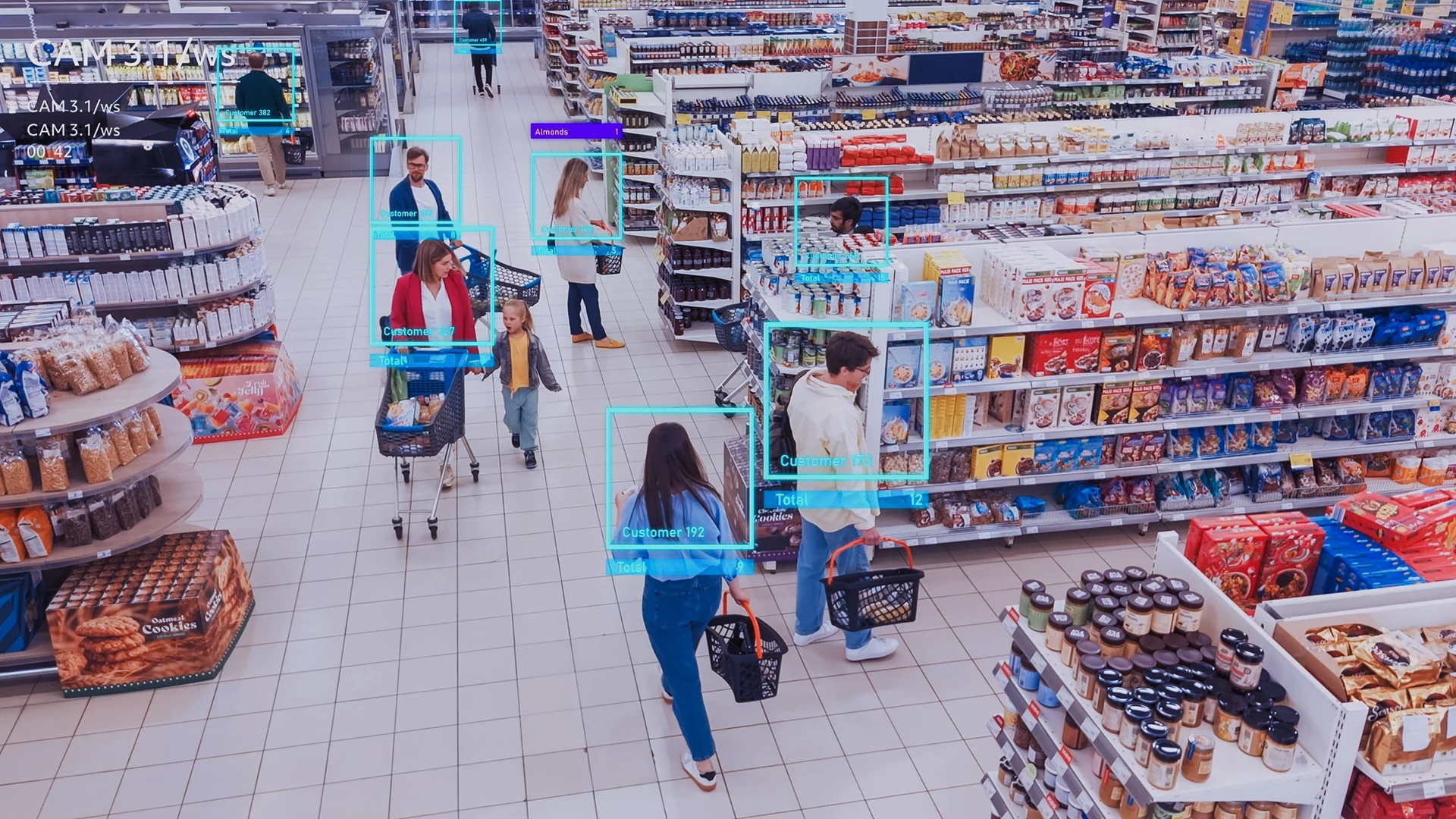


In the race for digital transformation, technology is evolving at an accelerated pace. Within this landscape, the concept of AIoT has been gaining ground in the market.
According to recent projections, the global AIoT market is expected to reach more than US$ 896 billion in investments by 2030, highlighting the growing relevance of this trend, which represents a new layer of the so-called Internet of Things through its fusion with Artificial Intelligence.
This combination creates smarter systems capable of learning, predicting behaviors, and automating decisions based on data. It impacts several sectors, including industry, healthcare, public management (smart cities), and especially retail, where the combination of physical devices and AI can be decisive for loss prevention, cost reduction, and strengthening retailers’ competitive advantages.
In this article, we take a deeper look at the AIoT concept and present its benefits for the retail sector.
What is AIoT (Artificial Intelligence of Things)?
AIoT is the fusion of the Internet of Things (IoT) with Artificial Intelligence (AI), enhancing an advanced technological ecosystem for businesses.
While IoT connects devices and collects data, AIoT goes further by interpreting and transforming this information into practical decisions in real time.
This combination represents a technological innovation leap that enables retail companies to optimize resources and gain agility in decision-making processes.
In practical terms, sensors collect data through IoT, while Artificial Intelligence algorithms interpret this information and act on it, creating smarter automated responses that adapt according to the context and needs of an organization.
What is the difference between IoT and AIoT?
Although AIoT is an evolution of the Internet of Things, it is important not to confuse these concepts.
IoT focuses on connecting devices and collecting data via the web, sending information to systems that control these physical devices.
AIoT, on the other hand, takes innovation a step further by using Artificial Intelligence to process data collected through devices and sensors, generate insights, and make autonomous decisions.
In retail, for example, IoT may simply monitor equipment and trigger alerts that originate from the combination of various data sources, but without additional interpretation.
AIoT, however, can combine computer vision and AI algorithms to detect process discrepancies, preventing failures and reducing losses.
AIoT benefits for retail
Implementing AIoT in retail brings a series of tangible benefits.
First, loss reduction stands out, as intelligent real-time analyses identify irregularities before they turn into critical operational problems in the store.
Another key advantage is process automation, which reduces operational costs and frees teams to focus on more strategic activities.
The customer experience also improves significantly, with more personalized, faster, and more efficient services.
In addition, decisions no longer rely solely on managers’ intuition but are based on concrete data.
This transformation increases competitiveness and strengthens retailers’ market positioning.
Examples of AIoT in consumers’ daily lives
AIoT is already part of many consumers’ routines, often almost imperceptibly.
Just as virtual assistants such as Alexa and Google Assistant integrate connected home devices with AI systems, allowing users to control household equipment, the same concept can be applied to retail back-office operations.
A relevant example is intelligent anti-theft systems that trigger predictive alarms, reducing losses in commercial environments.
Darwin Platform: AI Alerts revolutionizing management
In the retail context, Inwave’s solutions represent practical examples of successful AIoT application to drive retailers’ growth.
On the Darwin platform, a series of automatic real-time alerts enable proactive team actions, reducing losses, optimizing processes, and speeding up service.
- Unregistered movement alert: at the checkout, a computer vision–based AI alert identifies when there is product movement at the checkout without a corresponding record on the purchase receipt. This real-time alert on the Darwin platform has enabled retail chains to act proactively at the checkout, preventing losses before they occur.
- Alert for product in cart: also at the checkout, another AI alert from the Darwin platform can generate notifications when a shopping cart passes through without items being recorded on the receipt (when products should not be passing through the register) and even during an open transaction, to verify whether products were properly scanned. This feature aims to combat one of the main causes of checkout losses.
- Product concealment or consumption alert: in the sales area, a series of AI alerts detect suspicious movements to combat other common losses, such as concealing products in clothing or backpacks and even consuming items within the store.
These solutions reflect the potential of the fusion between IoT and AI, promoting innovation, efficiency, and competitive advantage for retail companies.
And the good news: we are talking about technological ecosystems that can adapt to different operating models—from large retail chains to expanding businesses looking to take the next step in security, loss prevention, and operational efficiency.
Conclusion: AIoT represents data-driven transformation
AIoT is much more than a technological evolution; it represents a structural transformation in how data is captured, analyzed, and applied across different sectors.
In retail, its impact is even more evident, increasing operational efficiency, reducing losses, and delivering personalized consumer experiences.
With solutions such as the Darwin Platform, Inwave demonstrates how this integration is already a reality in the global market.
Protect your profits with Inwave!


